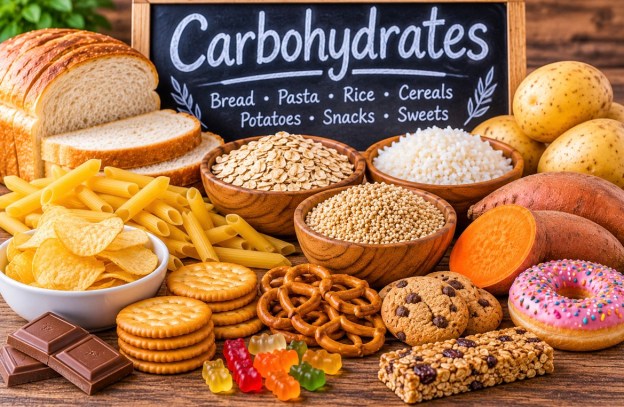
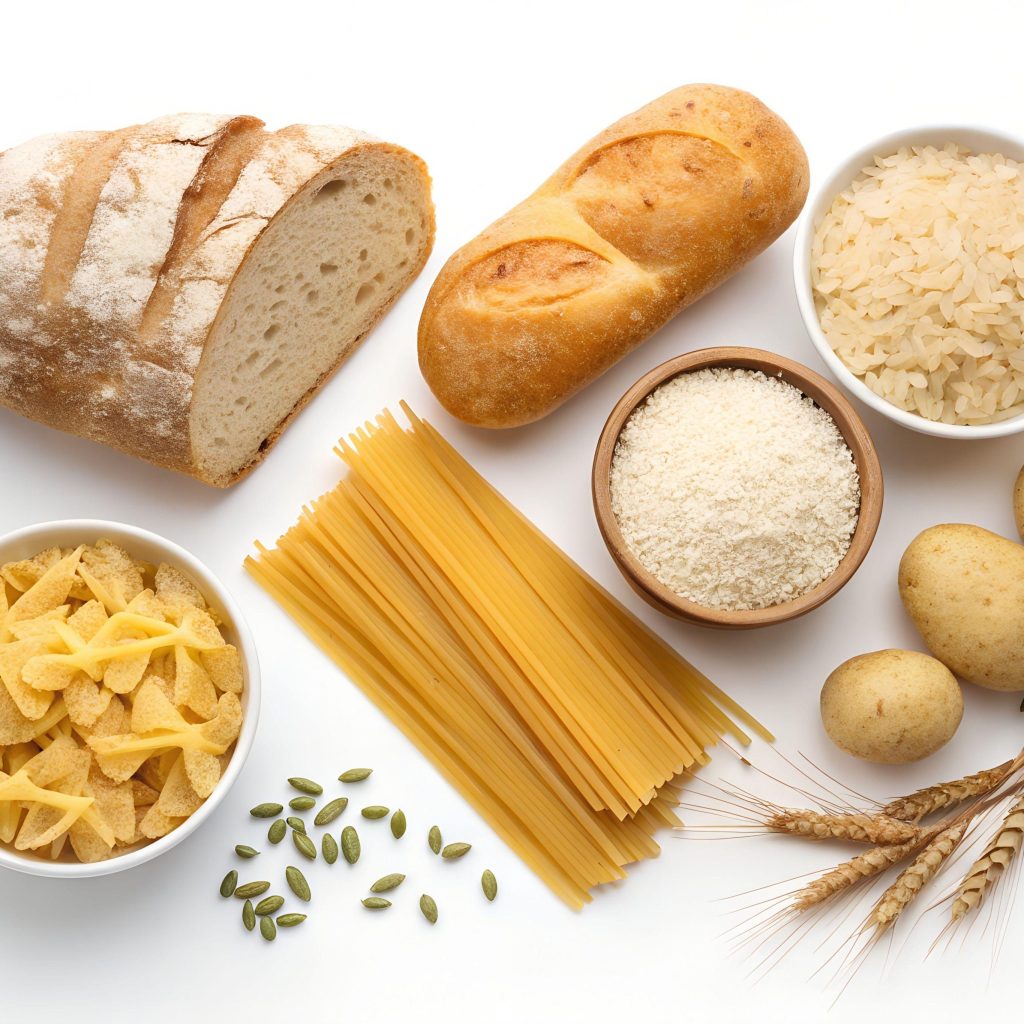
A carbohydrate is one of the three main nutrients found in food, alongside protein and fat.
Carbohydrates are made up of sugar molecules. When you eat them, your digestive system breaks many of them down into glucose (sugar), which your body can use for energy.
There are three main types of carbohydrate:
STARCHES
SUGARS
FIBRE
What happens when you eat carbohydrates?
Carbohydrates are broken down into glucose.
Glucose enters your bloodstream.
Your blood sugar rises.
Your body releases insulin to help move glucose into cells.
Interesting fact: Your body does not actually need to eat carbohydrates to survive. It can make the glucose it needs through a process called gluconeogenesis.
Your body does, however, need essential fatty acids and essential amino acids from your diet.
What Is Gluconeogenesis?
Gluconeogenesis is the process by which your body makes its own glucose (blood sugar) from sources other than carbohydrates.
Your body can make glucose from three main sources:
Protein: Certain amino acids from the protein you eat, such as beef, eggs and fish.
Glycerol: Released when your body breaks down stored body fat.
Lactate: Produced by muscles and other tissues during normal metabolism.
Where does it happen?
Your body has its own ability to manufacture glucose. This is why humans can survive without eating carbohydrates.
It’s made primarily in your liver, although your kidneys also contribute, particularly during prolonged fasting.
Screenshot
Summary of Carbohydrates / Sugar:
Your body regulates this process according to its needs.
You don’t need to eat sugar to maintain the minimal glucose your body requires.
How much sugar do you eat in day? If some of us are being honest, we know that we eat too much sugar. The biscuits or sweets that we tend to eat mid morning, and during that afternoon energy slump add up. I’m sure there are others who eat whole grains, with plenty of fibre, who would say that they don’t consume too much sugar.
Have a look below at an “unhealthy” day of eating, compared to a “healthy” day. The results might surprise you. The examples below are all taken from widely available UK high street retailers, though I haven’t named them, or the products specifically.
The important detail to know is that ALL carbohydrates turn into sugar when eaten, this may not be immediate, but it will happen. Also, this is the case for all of our bodies, NOT just diabetics. So when a label says carbs, read that as sugar.
Unhealthy day’s eating:
Breakfast: 3 crumpets, without jam – 58.2g carbs Pure apple juice. One glass, 150ml – 16.7g carbs Total breakfast carbs – 74.9, 18.7 teaspoons of sugar.
Lunch: A meal deal. Chicken mayo baguette – 62g carbs Ready salted crisps 45g – 23g carbs Can of fizzy drink – 35g carbs Total lunch carbs – 120g carbs, 30 teaspoons of sugar.
Dinner: Four cheese pizza 330g – 93.4g carbs Mini cup leading brand ice cream, 81g serving – 22.8g Total dinner carbs – 116.2g carbs, 29 teaspoons of sugar
Total daily 310.9g of carbs, 77.7 teaspoons of sugar.
Healthy day’s eating:
Breakfast: Superberry granola 50g – 31.7g carbs 50ml skimmed milk – 2.5g carbs Banana, avg flesh weight 100g – 23g carbs 100% pure squeezed orange juice, with bits. One glass, 150ml – 15g carbs Total breakfast carbs – 72.2g carbs, 18 teaspoons of sugar.
Lunch: Tuna and sweetcorn sandwich, on malted bread – 44.5g carbs 120g portion of mango chunks – 16.3g Smoothie drink, with added vitamins and no added sugar – 33g Total lunch carbs – 93.8g of carbs, 23.4 teaspoons of sugar
Dinner: Chicken breast – 0g carbs Sweet chilli dipping sauce, 29g serving – 12.2g carbs Brown rice, 75g uncooked weight – 65.3g carbs Leading brand steamed vegetable bag – 9.8g carbs Total dinner carbs – 87.3g of carbs, 21.8 teaspoons of sugar
Total daily – 253.3g of carbs, 63.3 teaspoons of sugar
Please take a look at the YouTube we have linked, Richard Smith explains extremely well the impact of sugar on our body. Each time we consume over one teaspoon of sugar, which is just 4g, our body has to use insulin to offset the glycemic load.
I have been told in the past that a Ketogenic lifestyle is unhealthy and dangerous. The NHS recommendation for daily “free” sugar intake is no more 30g, and to eat a therapeutic Keto diet is to have no more than 20g of total carbs a day. I don’t believe that our pancreas can detect a difference between a naturally occurring sugar, and an added sugar. So the insulin responds to the glycemic load. So can eating 10g fewer carbs in a day than the Govt advises be dangerous? Please have a look for Dr David Unwin, he is lovely NHS GP, who has made a hugely positive impact in his practice. He is, in my mind, showing the NHS how it should be done, showing how beneficial lowering carbs can be for our health.
The Sugar Burden
Common Foods
A Common Breakfast
Breakfast Cereals
I have lost over 6 stone since I realised that eating fat wasn’t the problem, it was eating low fat and high sugar that was hurting me. Simon, my husband, put his Diabetes type 2 into remission by eating this way. His T2 diabetes has not been “cured”, because if he were to start eating high carb, therefore high sugar again, his blood glucose would increase quickly. This is why it is only in remission, not cured. So I don’t see how the Keto diet can be dangerous.
Don’t blame the fat for what the sugar did.
Yet again, these are purely my own thoughts, based on our experience and research. This is not medical advice, just sharing what has helped us.